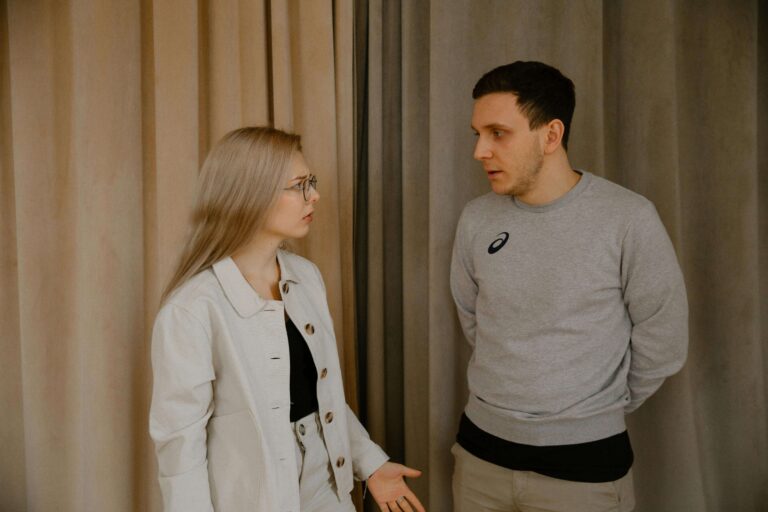
In every relationship, there comes a moment when something feels “off,” but you can’t quite put your finger on why. You feel drained after conversations that should feel simple. You feel responsible for emotions that aren’t yours. You say yes when every part of you wants to say no. You shrink yourself to avoid conflict or stretch yourself to keep the peace. And slowly, without realizing it, you begin to disappear inside the relationship.
This is what happens when boundaries are missing.
Most people don’t realize that boundaries are not walls, punishments, or restrictions. They are clear. They are emotional safety. It’s the quiet framework that allows love to breathe. And without them, even the strongest relationships begin to fray under the weight of unspoken needs, hidden resentments, and emotional exhaustion.
At Therapy Ties, we see it every day in relationship therapy. Couples who love each other deeply but are drowning in unmet expectations. Individuals who feel guilty for having needs at all. Partners who confuse self-sacrifice with connection. And everywhere, misunderstanding, because no one ever taught them how to build boundaries that protect the relationship instead of threatening it.

What Boundaries Really Are—and What They’re Not
A boundary is simply an understanding of what feels respectful, safe, and emotionally aligned for you. It is the ability to say, “This is okay for me,” and “This is not okay for me,” without shame or fear. It is knowing where you end, and another person begins. And it is the foundation of every healthy partnership.
But for many of us, boundaries feel foreign. We were raised to be “easy,” “pleasant,” “strong,” or “selfless.” We learned to ignore our limits because life demanded it. We learned to stay quiet to avoid conflict. We learned to take on everything ourselves because asking for help felt like burdening others. Boundaries were not modeled; they were mislabeled as selfishness or weakness.
So when we enter intimate relationships as adults, we carry these patterns with us. We over-function while our partner under-functions. We become the emotional shock absorber for the entire household. We internalize guilt for setting limits. And at the same time, we silently long for the relationship to feel balanced, mutual, and respectful again.
The truth is simple: boundaries do not push people away. Lack of boundaries does.
Why Do Boundaries Matter in Relationships?
When boundaries are missing, the relationship becomes unclear. Expectations collide. Resentments build. One partner feels overwhelmed; the other feels confused. Arguments escalate because the real issues are never directly addressed. And intimacy weakens because neither person feels fully safe to be themselves.
Boundaries are what bring clarity back.
Boundaries teach your partner how to love you well. They show you how to stay connected without losing yourself. Boundaries allow conflict to be resolved without emotional damage. They create space for individuality inside togetherness.
A relationship without boundaries is like a home without structure; everything collapses into everything else. But when boundaries are present, the relationship becomes grounded, intentional, and emotionally spacious.
How Do Boundary Problems Show Up in Real Life?
Boundary issues rarely announce themselves. They appear quietly, in the small moments:
- Cancelling your plans because your partner is upset.
- Apologizing to keep the peace even when you’re not in the wrong.
- Absorbing your partner’s stress as if it’s your responsibility to fix.
- Feeling guilty resting because you worry about how it looks.
- Avoiding hard conversations to prevent conflict.
- Exploding after weeks of silence because you feel unheard.
Some people were never taught what healthy boundaries look like. If you grew up in a home where love was inconsistent, where emotions were dismissed, or where you had to be “easy,” “strong,” or “low-maintenance” to be accepted, boundaries may have felt dangerous. And if you grew up in an enmeshed family, where personal space, emotional independence, or privacy didn’t exist, you may have learned that boundaries were the same as distance, punishment, or disconnection. You may have learned that saying “no” harms the relationship or that asking for space means you don’t love someone enough.
None of these behaviors means you’re unhealthy or failing. They mean you’re human. They mean you adapted to survive past environments where emotional expression was unsafe or where your needs were minimized. You learned to sense the mood in the room before you sensed your own. You learned that staying close, even if it meant shrinking yourself, kept the peace. You learned to cope the best way you could.
And here’s the beautiful part: What you learned to do to survive doesn’t have to be what you continue to do to love. Therapy helps you gently unlearn the idea that boundaries push people away and replace it with the truth: healthy boundaries bring people closer, because they let you show up authentically without fear.

Boundaries and Vulnerability: The Connection Most People Miss
When you learn that you can count on yourself to place boundaries with others, you become more able to show up without masks, without the pleaser mentality, and without the fear that your needs are “too much.” Boundaries create the internal safety that allows authenticity to exist.
Many people believe boundaries push others away, when in reality, boundaries make vulnerability possible. When you know your limits matter, when you know your voice will not be dismissed, when you know you are safe to say no, something shifts. You open up more fully. You trust more easily. You let your partner in more deeply.
Boundaries don’t build walls. They build clarity. And clarity builds connection. Boundaries create the emotional safety that vulnerability needs. A relationship becomes intimate not because two people merge into one, but because two whole individuals choose one another from a place of clarity, strength, and truth.
How Relationship Therapy Can Help You Build Healthy Boundaries
Establishing boundaries on your own can be incredibly difficult, especially if you were raised to believe that your needs are inconvenient, emotional independence is the only way to avoid conflict, or love must be earned through sacrifice. That is why therapy becomes a powerful space for healing and learning.
In relationship therapy, you explore the roots of your boundary struggles. Our relationship therapists can help you gain insight into where your patterns came from and why your body reacts the way it does when you try to assert your needs. You learn what a healthy boundary sounds like: calm, confident, and clear, rather than reactive or defensive. And you practice communicating authentically without abandoning yourself or attacking your partner.
For couples, therapy creates a protected space to rewrite the rules of engagement. Rather than blaming or defending, you learn to express needs directly and respectfully. You learn how to listen without taking things personally. You learn to understand each other’s internal worlds instead of assuming intention. And together, you build boundaries that strengthen the relationship rather than divide it.
Relationship therapy turns boundaries from something scary into something empowering.
It teaches you that your needs are not a burden. Your limits are not negotiable. Your voice is not optional. And your relationship is healthier when both partners can say yes freely and no honestly.
Final Thoughts
Boundaries are not the end of closeness; they are the beginning of it. They protect your emotional energy, preserve your individuality, and create a foundation where love can grow without resentment or fear. They allow each partner to show up authentically, without needing to hide or overextend.
At Therapy Ties, we help individuals and couples build boundaries with compassion, clarity, and emotional safety. Because when you learn how to honor yourself, you also learn how to truly connect with the person you love. Boundaries are the quiet power that transforms relationships from chaotic and draining into grounded, respectful, and deeply intimate.
Healthy love does not demand your self-abandonment. It asks for your truth. And boundaries are what make that truth possible.

Rebuilding Emotional Safety Through Boundaries in Relationship Therapy in Los Angeles, CA
If you feel like you’re losing yourself in your relationship, relationship therapy in Los Angeles, CA can help you understand why boundaries feel so hard and how to rebuild emotional safety without guilt or fear. In therapy, you’ll learn how to honor your needs, communicate clearly, and stay connected without self-abandonment. At Therapy Ties, we support individuals and couples in creating boundaries that don’t push love away—but allow it to finally feel secure, balanced, and deeply authentic. Follow these three simple steps to get started:
- Schedule a free 15-minute consultation to see if relationship therapy in Los Angeles, CA is right for you.
- Meet with supportive relationship therapist Liron to help you and your partner create boundaries.
- Begin rebuilding emotional safety through healthy boundaries!
Additional Services Offered at Therapy Ties in Los Angeles, CA
At Therapy Ties, I work with individuals and couples to uncover the boundary patterns that quietly shape communication, emotional closeness, and self-abandonment in relationships. Through increased self-awareness and learning how to express needs with honesty and care, clients begin building the emotional safety required for lasting, authentic connections. In addition to relationship therapy in Los Angeles, I offer individual therapy, couples therapy, and anger management, serving Woodland Hills, West Hills, Agoura Hills, Encino, Tarzana, Sherman Oaks, North Hollywood, and the greater Valley—providing a grounded, supportive space to break old relational cycles and reconnect with yourself and those you love.
About The Author
Hi, I’m Liron, a Licensed Marriage and Family Therapist and the founder of Therapy Ties in Woodland Hills. I support individuals and couples who want to better understand their emotional responses, relational patterns, and the ways they may lose themselves in connection. My approach is relational and experiential, drawing from Humanistic therapy, Emotion-Focused Therapy, Gestalt methods, and Family Systems to help clients feel more present, emotionally secure, and empowered to create change.
I earned my Master’s in Marriage and Family Therapy from Phillips Graduate Institute and a BA in Psychology from UCLA, and I am fluent in both Hebrew and English. As a CAMS III–certified anger management specialist, I work with clients to navigate intense emotions, interrupt unhelpful cycles, and develop more grounded, intentional ways of communicating.
If you’re looking to deepen your relationship with yourself and show up more authentically with others, I invite you to connect and take the next step toward meaningful growth.